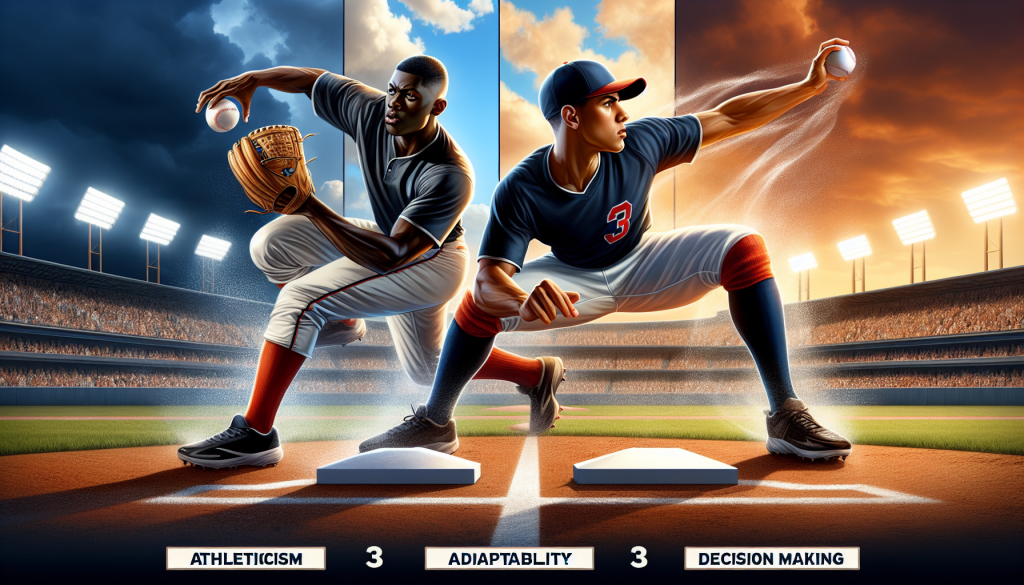
Understanding “The Big 3”, Athleticism, Adaptability, and Decision Making…
“I must create an elite training environment,” said no coach ever. Practices and training sessions are created and have been created by coaches based on players, personnel, and time!! But what if I told you that it is possible to create elite training environments with limited time, resources, and staff. How? you ask.. Let’s get started!!
Athleticism
One key aspect of elite training environments is allowing players to display their athleticism. As coaches we must understand that there is really not just one way to field a ground ball, throw a baseball, or swing a bat. We can, however, agree that there are some ways to do these things much easier than others. In the game of baseball there are a wide variety of play changing variables that a player must take into consideration before fielding a ball; speed of baseball, baserunner, lefty , righty, and the list goes on and on. By promoting athleticism, and encouraging players to explore their limitations we are allowing players to understand what their bodies can do physically and decide if it was the right or wrong play at that moment based on the outcome.
Adaptability
Furthermore, as baseball coaches at some point or another we have all said the frase, “you need to know what to do if the ball is hit to you,” In my short time working with baseball great Darren Fenster I’ve learned that there is a better frase. “Know what you can do if the ball is hit to you.” If as a player you know what you can do physically to field a ball wherever it is hit then it opens the window to what I’m going to do with it if it is hit to me. There is one thing and one thing only in the game of baseball that determines what a player does and that is what the baseball is doing, players need to adapt to what the ball is doing in situations where they need to do something different physically than what they thought they would do if the ball is hit to them. But if I know what my physical capabilities are then it’s easier to adapt and make more plays more frequent!!
Decision Making
Guilty as charged!! I was once a firm believer that “mass fungo” for large amounts of reps was the best way to develop elite infielders… I was wrong…
The best method to develop athletes, that are adaptable to any situation and can make good de decisions on the field is to train with context and constraints. An example of adding situational context in training environments is simply by giving the players the number of outs, score, baserunners, and speed of the baserunners. So, if you have Elly De La Cruz as runner in first base, with 1 out and Billy Hamilton at the plate the chances of turning a double play are minimal. The player must then make the decision based on what the batted ball is doing to determine their play. If the ball is hit hard on the ground if fielded cleanly there might be a chance for 2, however, if the ball is hit softy there might only be a chance at first.
Adding a physical constraint now adds the degree of difficulty and challenges the player mentally and physically. If we stick to the same scenario above, the constraint can be as simple as making the players field everything with a backhand no matter where the ball is batted. Now the constraint complicates the decision making process, and calls for some teaching/learning moments, and failures.
To conclude, “The Big 3” happen in games all the time so incorporating them in challenging training environments will make players better in game situations!!
 Coach’s Corner
Leave a comment